Showing posts with label Film Reflections. Show all posts

Sunday, January 28, 2024

MIND-ALTERING SUNDANCE 2024

website: https://www.jamesawicks.com    contact: jawicks75@gmail.com

Once again, in its continued tradition running 40 years strong now, Sundance films exactly do not fit into that tiny range of experience that capital seems to require of us to replicate itself. I'm probably off course by making this over-simplified conclusion at the outset of this post, yet do find that the requisite skills neoliberal culture seems to value above all others, including working overtime, war mongering, and stepping over others to get ahead, can be boiled down to the rather simplistic and leave us empty. No wonder people are unhappy even when they "make it": we're starving for more on spiritual, physical, and intellectual levels. 

Sundance films explore the realms outside of our window of restricted vocations, interactions, and culture. The categories Sundance films explore aren't inherently complex, but since they're just a bit outside the norm, it's a breath of fresh air.

Monday Jan. 22, 2024

Malu (2024) was delivered by Brazilian director Pedro Freire who explained before the screening I attended that back in the day, when he rented films from video stores, he grew to love Sundance films because the laurel stamped on each film's cover ensured that the story would at the least be well scripted and well acted--his two favorite things--and that he wept when he found that Malu was selected for the festival this year. The film traces the story of a woman pitted between her 20-something daughter and conservative aging mother. Malu lives straddled between the past (failed communist revolution) and the future (unrealized dream of creating a theater company) with neither emotional nor intellectual reserves to manage the present in spite of the charm and gravitational pull of her personality. 

Malu director and cast, Sundance, 2024

In the evening I attended the Midnight Short Film Program--Sundance’s violent and un-categorizable fare--featuring 6 of the 53 short films submitted to Sundance out of 12,098 (including one of mine lol). The buzz of the crowd even before entering the theater was palpable. Once inside unfiltered anxiety, fear, and joy melded together throughout the welcome, screenings, and Q&A session. My favorite film of the fest--the singular "The Rainbow Bridge" (Simakis), which comically and nearly savagely presents a pet owner who discovers how to connect with her dying pet on a celestial plane so that she can say goodbye in a language they can both understand--typified the collection of films here with loglines that search engine algorithms can't quite quantify. 

Sundance programming is at it’s best when the out of this world meets a community there for it. I left the theater after the Midnight Shorts wondering “do I know too little or do I know too much?” and before settling on “probably neither," the realization that followed on its heels was “anything is possible." It's a certainty the films revealed by pulling ideas out from under the rug where concepts of infinite possibility can unwittingly be swept.

Tuesday Jan. 23, 2024

Love Machina (Sillen) documents the love story of Bina Rothblatt, currently in the process of downloading her memories into an AI system, and her partner Martine. The idea is that if we can create eternal versions of ourselves, then maybe we can love our partners forever. But part and parcel are questions surrounding consciousness, sentience, and immortality--not to mention the structural and systemic biases built into the foundation of systems and platforms from which AI is being built.

Winner (Fogel), featuring the pitch-perfect performance of Emilia Jones (who plays Ruby in CODA), tells the story of Reality Winner, a woman who at great personal cost sent private NSA documents to mainstream journalists which proved Russia interfered with the United State's 2016 elections. The film shows important events that preceded and those that followed this explosive event covered in the press, based on a smart, well-paced script. 

Presence is Soderbergh’s horror-drama of a spirit which haunts a house from the perspective of the haunting presence. Once the idea that first-person point of view will be used exclusively to tell the story, and after a handful of lines fall flat in the first 20 minutes or so, the film is an intriguing whodunit and quite enjoyable. The music is what particularly stands out in a film which rewards patient attention.

Wednesday Jan. 24, 2024

Never Look Back (Lawless) traces the radical life of the singular, remarkable camerawoman Margaret Moth, war correspondent extraordinaire. Extraordinaire in this case refers to a person instilled with a will to live with fearlessness which, while perhaps not replicable, does indeed provide a model of living to the fullest to inspire each individual within their own capacity. And Margaret Moth had the coolest 80s jet black punk hair, just saying. 

I had tickets at the beginning of the festival to the Napoleon Dynamite 20th anniversary screening yet nearly thought of giving them away (because I've seen it so many times!). But as the date approached I kept thinking: what if the cast and crew are there? And they were! Director Jared Hess stated via a recorded message that at the film's first screening at Sundance 20 years ago there were no opening credits--the film just opened with Napoleon standing in front of his house. 

Napoleon Dynamite cast, Sundance, 2024

It was so awesome to re-live the film with so many passionate fans. We clapped for each new character introduced and voiced multiple cheers for Napoleon's antics and groans for Uncle Rico's behavior. It was an unforgettable night for all. Even the principal and Trisha were there! I may or may not have cried during the screening. And after the screening I may or may not have been photographed with Lafawnduh (Shondrella Avery) kissing my cheek, but I’m not the kind of guy who gets kissed on the cheek after a film screening and then tells.

Thursday Jan. 25, 2024

Richard Linklater returned to Sundance with Hit Man, staring Glen Powell (Top Gun: Maverick) and Adria Arjona (Andor), which I think of as a modern-day Fight Club (Fincher, 1999) in terms of the way the main character lives two identities. In this case, and based on an actual story, a college professor spends his off hours (I’d like a professor gig that has enough time for a part-time job, just saying) as an undercover contract killer for his city’s police department. The false identity Glen Powell's character creates bleeds into his “real life”-- the result? He has to pay for the repercussions of his transgressions, or does he?  

And so, are we re-entering an age of schizophrenic films just as we did at the end of the late 1990s, pre-9/11? At that time my supposition is that Generation X had endured sufficient time to take stock of the effects of global capital on the local psyche--and within this space for introspection filmmakers represented their meditations across cinematic genres. And Linklater was in the thick of it then, so maybe like those of us who experienced the late 90s he persists in producing what was then part of our daily lives: picking up the pieces of psyche’s fractured by the impact of living to make money in a society that, no matter how we went about doing so, we could not seem to escape the realization that we were contributing to structural and systemic inequality. 

Does Hit Man reveal the return of the repressed or are we at a new juncture in time--that is to say, is 2024 a moment when we have had enough time (since the pandemic, since Black Lives Matter, since Me Too) to take stock of all that we've inherited and all that persists, or is this the 1990s returning in a new dress? (And just as with today's return of 1990s fashion, accompanied and intermixed with the 80s and 00s haphazardly?)

Little Death (Begert) channels Fight Club directly during the first half--it's like watching Fight Club if it were written from a right rather than left-wing ethos and with the assistance of AI. The second half (thankfully) is something altogether different--the film radically changes course, as if two separate movies were crammed into one--which was Little Death's best quality.

So when I say "mind-altering Sundance" films in this blog's title, it’s not that these films are beyond the possible range of human experience in terms of gender, race, and class; rather, our cultural range of experience is limited and Sundance proves that. Moreover, their films become the new normal during the time folks are in attendance. The window gets cracked open a bit wider.


Park City photography © by James Wicks, 2024

Friday, January 31, 2020

Possessor (Cronenberg, 2019): Sundance 2020

Sundance Film Festival promotional image for Possessor

Possosser (Cronenberg, 2019) was described by the delightful Sundance programmer at my screening yesterday as the biggest mindf*** of the festival, and next she informed us that since the director was not present “none of our questions would be answered.” Both proved to be true.

The film details the life of an assassin (Andrea Riseborough) who works for a firm (its head portrayed by Jennifer Jason Leigh) that links its assassins via a mind-meld machine into an unsuspecting individual who carries out the murder assignment and then commits suicide so that the corporation might get away scot-free. By portraying a hit carried out relatively smoothly within the first five minutes, the story-tellers implant (pun intended) a template of the film’s notion of normalcy before the second hit goes horribly wrong.

Possessor fits into a recent iteration of film that takes a spiritual notion, both in terms of theology and film tradition, and strips away all of the platonic notions of forms/ideas and focuses on the material alone. For example, the shape of the Stranger Things narrative revolves around the idea that an ominous, powerful force can be explained via scientific calculations, even while conveying its story via stylistic techniques that historically were used to evoke the demonic or satanic as representative of dark, evil properties—a haunting score, distorted unintelligible voices, and the like. 

Similarly, in Possessor the notion of a spiritual entity inhabiting a human body is represented as an entirely scientific, rational achievement. Meanwhile, the soundscape alludes to horror films which intentionally set out to portray spiritual phenomena. What fascinates me is the way the absence of a spiritual realm within the scientific, existentialist worlds of these films successfully reproduces the very sense of spiritual darkness that previous filmmakers conveyed by accentuating its existence.

I also found in Possessor perhaps the best filmic exploration of our current social experiment: social media.

Painting with very (extremely) wide brush strokes for a moment, people once lived in relatively isolated communities in which fireside narratives were retold in ways that sustained belief systems that clashed with the point of view of others upon intersection. True, entirely simplistic, but I mention this only to contrast it with the present in which the most entrenched views (hi there, Twitter) are seemingly in constant, persistent, continual contact with alternate points of view. 

The trial for many these days is the struggle to maintain a sense of identity within certain communities that attempt to pass down their own stories, but at the same time continually and inevitably encounter compelling counter-narratives. While I personally remain hopeful for a future in which this trial results in a solution and the arrival at perhaps a new home (following Campbell’s heroic journey model), Possessor focuses on the anger and rage this situation—constantly encountering multiple ideas that may appear at once threatening and equally viable—causes.

Moreover, these notions are not an abstract concepts in Possessor, but actual, lived experience. By portraying an individual placed into the body of another gender, ethnicity, and class, the film viscerally represents what it is like to embody an entirely different perspective. It is no wonder that the protagonist tends to avoid firearms when her/his bloody rampage commences, for pulling a trigger seems incapable of the type of catharsis repeated hacking gestures (with a knife or some other bludgeoning weapon—you have to see it) provides.

If the film is any indication, our social experiment has a few rough patches to undergo before the majority become used to encountering the other. After all, we’re physically linked.

Monday, September 2, 2019

"Clarifying Street Culture: Integrating a Diversity of Opinions and Voices"

It was a pleasure to work alongside G. James Daichendt, Sebastian Kurtenbach, Paul Gilchrist, and Monique Charles and to be invited by Criminologist Jeffrey Ian Ross (follow his work on Twitter @jeffreyianross) to co-author the article: "Clarifying Street Culture: Integrating a Diversity of Opinions and Voices," published in Urban Research & Practice (22 June 2019).

As presented in the abstract: "This article synthesizes current ideas about the study of street culture by examining six major questions that street culture researchers currently grapple with. The article outlines suggestions for improving scholarship in this field," for "despite the frequency of its usage in the social sciences, urban planning, and selected areas of the visual arts, rarely is the term street culture defined and when it is, the definitions are often conceptually lacking."

Interestingly, this collaborative project began as a Twitter chat with #streetculture on Sept. 8, 2018--each participant responded to questions about the way "street culture" is defined within their respective academic field of study. The resulting article is available here.

Friday, February 1, 2019

Sundance Film Festival 2019, Thursday 1/31

Hala (Minhal Baig, 2019)

Minhal Baig's film Hala depicts the experiences of a young woman during her senior year of high school in the U.S. Hala is a bright thinker and student, a skater, and a good friend whose day to day decisions are shaped by the framework of her family's Pakistani American experience. Director Baig mentioned at the screening that film is an empathy machine, and indeed numerous scenes are coupled with dramatic soundscapes that heighten the all-or-nothing importance high school experiences are imbued with. Just as an action film goes all in on explosions, or a romcom goes all in on scenes on top of famous landmarks, this film shows how riding the bus on the way to school can be filled with the entire sum total of a high school student's existence. And why not? It's worthwhile to feel the emotions Hala undergoes and witness the way she navigates her life's predicaments while she learns new insights along the way.

Photo by James Wicks, 2019.

Thursday, January 31, 2019

Sundance Film Festival 2019, Wednesday 1/30

Hail, Satan? (Penny Lane, 2019)

The rapid rise of The Satanic Temple is documented in Penny Lane's incredible and important documentary. Using a light-hearted soundtrack and comical soundbites that bring to light the absurdities of the Christian right in the U.S., the film begins with a publicity stunt the TST initiated in 2013 and traces the growth of the movement to the present. While focusing primarily on the national rise of the TST from the 1950s to the present, we are also allowed access to individual stories, personal accounts of the ways the cultural hegemony of the Christian right ostracized people in the past, and strives to keep the other out by maintaining political power today.

Hail Satan?, 2019

The TST appears to be disruptive because it is cognizantly adding new idols to be placed next to old idols already established and in place. The film makes it painfully obvious that it is hard to let go of cultural artifacts and ideas that are attributed with meaning, and that mockery is uncomfortable for whomever is the recipient. At the end of the day, everyone--regardless of political and religious perspective--who watches it is faced with a choice of working together across ideological lines, or maintaining divisive views accompanied by violence and all of its dark corollaries.

Native Son (Rashid Johnson, 2019)

Rashid Johnson's first film Native Son has one of the best character portrayals of the Sundance Film Festival this year: Ashton Sanders, who plays protagonist Bigger Thomas. Additionally, the editing is unbelievably effective. Certain events are slowed down, allowing contemplation, while narrative economy at other junctures drives the narrative forward at pace. The trust the director has in his ability to allow the story to flow translates, at least in my case, to an audience who is more than willing to trust the storytellers (all of the crew deserves credit for the soundtrack, editing, characterization, costume design...) and go along for the ride. In terms of the adaptation of Richard Wright's great American novel, I wouldn't have minded if more creative license were to be taken to alter plot details so that the story could match the absurdity and tragedy of the present in even more ways. Yet without a doubt, the horror of double consciousness is captured here and the tragedy that Native Son is still relevant today is represented clearly.

Wednesday, January 30, 2019

Sundance Film Festival 2019, Tuesday 1/29

Director Chinonye Chukwu at Windrider, 2019

Clemency (Chinonye Chukwu, 2019)

I loved Clemency, a slow-paced, dark (both thematically and in terms of its over-exposed film), and lucid portrayal of the weight of responsibility on a warden in charge of inmates on death row. The soundscape, mise-en-scène, and editing are superb. Shots early in the film are slightly tilted so that the angles generate tension rather than tranquility as I attempt to depict in these hasty film notes below:

Clemency film notes, 2019

By delving into the life of the warden, portrayed perfectly by Alfre Woodard, and her interaction with activists, lawyers, family members, and an ostensibly falsely accused inmate (Aldis Hodge), the pressure of the prison system in the U.S. is tangible in all of its complexity in terms of race, class, and gender. While an incredibly slow film in comparison with mainstream releases, I hope the topics this narrative suspend find their place in broad dialogue.

Luce (Julius Onah, 2019)

Julius Onah's Luce is an adaptation of a play that portrays an incredibly successful African-American high school student who was adopted from Africa at age 10 by two white parents. The cast is perfect: Naomi Watts, Octavia Spencer, Tim Roth, and Kelvin Harrison Jr. The challenges and privileges each character in the film experience, the messy contradictions each character is caught within, and the way each character walks right up to the line without resolution is worth further contemplation. Poignant and relevant questions will ensure this film sees a wide release even though it is nearly un-classifiable as (all three) a coming-of-age, thriller, and high school film.

Luce, 2019

Sundance Film Festival 2019, Monday 1/28

Bedlam (Kenneth Paul Rosenberg, 2019)

Bedlam covers the disastrous management of mental illness in the U.S today. Director Ken Rosenberg mentioned before the film that when he set out to document this crisis, he did not know that he would be a participant in the narrative. Yet indeed, mental health issues impacted his older sister and thus the director's participation in his subject matter directly. This story of the U.S. mentally ill begins with the housing of patients in state-funded asylums and "progresses" to today when these citizens are on living in the streets, filling ER beds, incarcerated, or living at home under the full-time care of families. We have an epidemic on our hands.

Bedlam, 2019

This Is Personal (Amy Berg, 2019)

Amy Berg's latest documentary describes the woman's march movement from 2016-18 and outlines the work of two incredible activists Tamika D. Mallory, and Erika Andiola. Berg deftly interweaves the local narratives alongside the national narrative in a way that is both informative and personal. The documentary allows Mallory and Andiola's stories to move from 2D internet click-bait to 3D personalities. The ending of the narrative oddly focuses on one particular issue at the expense of the entire story, so my guess will be that the doc will be re-edited before release. I hope This is Personal receives widespread attention.

This is Personal, 2019

The Nightingale (Jennifer Kent, 2019)

Jennifer Kent's revenge thriller, almost universally characterized as brutal, is set during British-colonialism in Tasmania. The protagonist Clare's family is murdered in an almost unfathomably disturbing way. Although the story develops slowly (there is no narrative economy in the vein of Spider-man: Into the Spiderverse), each detail justifies Clare's desire to track down and kill each of the perpetrators. Like Kent's 2014 film The Babadook, the rhythm of the editing is singular to the director's vision to the joy or dismay of her audience, depending on their preference. And once again, clear thematic elements, in this case including the savagery of colonization and the need for inter-racial harmony, guide the story to its conclusion.


Sunday, July 29, 2018

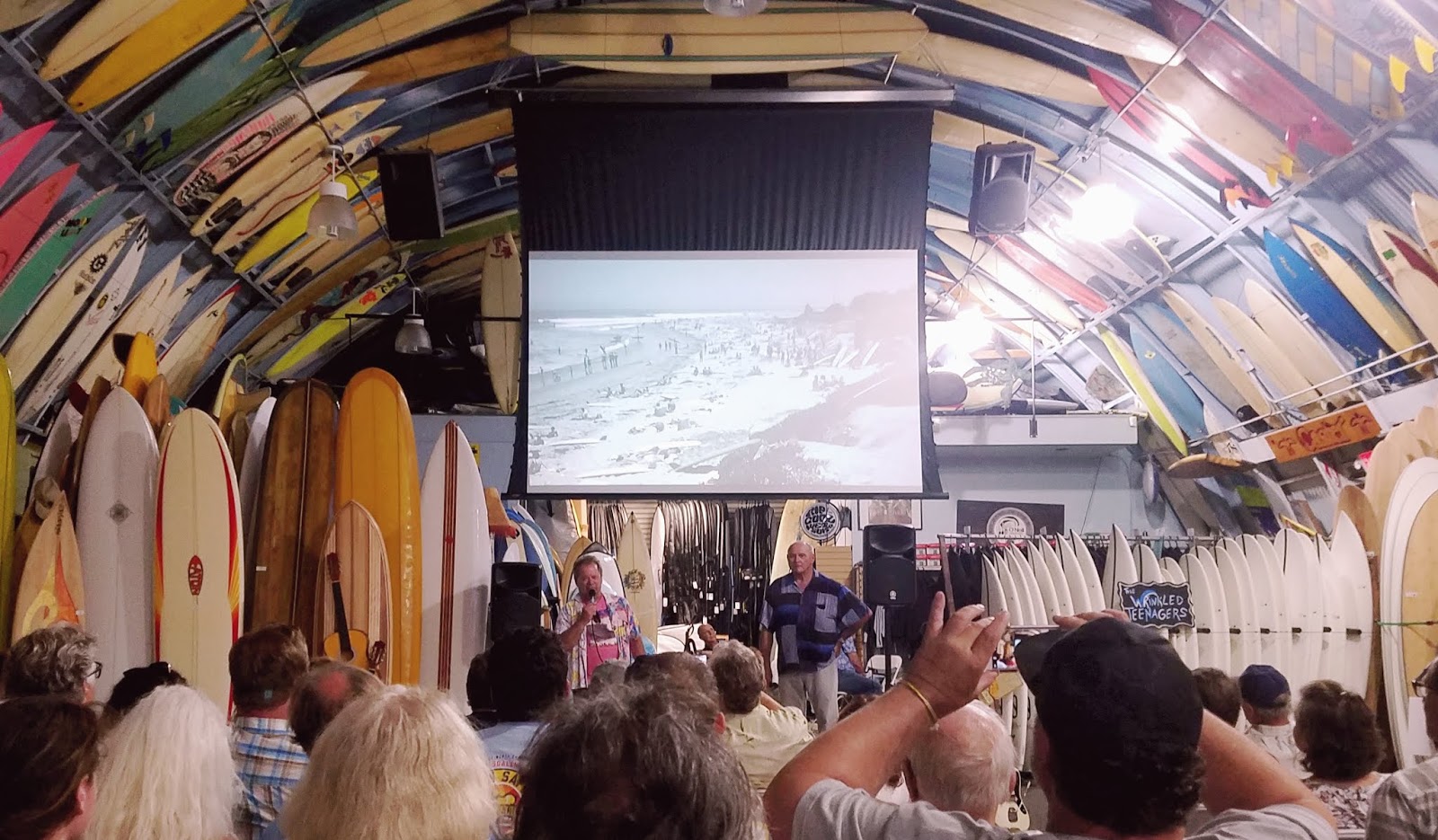
Big Wednesday: 40th Anniversary Screening at Bird's Surf Shed

On July 28th, 2018 Bird's Surf Shed hosted a surf film screening so surfer's could come out of the woodwork, hoot and holler at the screen, and have a great time together. Proceeds supported the UC San Diego Moores Cancer Center.

PT and Ian Cains at Bird's Surf Shed

In addition to watching Big Wednesday (Milius, 1978), stunt doubles were there to talk story: Ian Cairns and Peter Townend--surfing icons in their own right. Ira Opper shared behind-the-scenes photographs, and co-writer Dennis Aaberg narrated a video about the making of the movie. Pre-screening activities, music (the Wrinkled Teenagers!) and story, took around two hours so I actually left at the intermission before the film started, but I've seen it before and look forward to seeing it again after this experience.

Monday, June 18, 2018

Film Reviews: Taiwan Cinema Toolkit 臺灣電影工具箱

Created by the Taiwan Ministry of Culture and selected by the Taiwan Film Institute, the Taiwan Cinema Toolkit 臺灣電影工具箱 is a collection of films available for non-profit public screenings. Each film offers a unique insight into Taiwan's rich cinema history.


Links to my reviews of films from two of these collections are below--I'll keep adding films to this page until all of the films are reviewed. -- jw

2016 Taiwan Cinema Toolkit  (32 films)
Showcase, 2016 (22 films)


Wednesday, July 19, 2017

Baby Driver is Guardians of the Galaxy

Really enjoyed Baby Driver (Wright, 2017). It begins with a car chase that puts the opening car chase in Drive (Refn, 2011) to shame, then puts Drive in its entirety in the rear view mirror after that.

But I keep coming back to the connections between Baby Driver and Guardians of the Galaxy though (both vols, Gunn, 2014 & 2017). Ok, they're not exactly the same, but:


A young protagonist who lost his mother at a young age...
absorbs himself in music (fortunately we can hear what's playing through those earphones)...
works on the wrong side of the law...
but has a noble heart and purpose...
as he pursues the love of this life.

Not complaining, just saying!

Monday, July 17, 2017

YouTube Lecture: CSUSB Modern China Lecture Series

My lecture by invitation, “Sympathetic Views of Japan in Café Lumière & Riding Alone for Thousands of Miles,” is below. It was delivered on April 20th, 2017 at California State University, San Bernardino.

You can access the conclusion of the paper first by clicking the link here.

Via the YouTube channel: CSUSB Modern China Lecture Series

A couple stills from the lecture:


A Brighter Summer Day (Yang, 1991): Mini-Film Review


Edward Yang's epic work A Brighter Summer Day records more insightfully than any film in its class, a singular moment in Taiwan in the early 1960s. The nearly four hour film, which took three years to make, based on a script with more than 100 characters who deliver their own distinct lines of dialogue, documents a teenage boy's psychological descent in an era of transition generationally, politically, and culturally.

It is without a doubt a masterwork. So when I find myself hesitating to recommend the movie to those who are not familiar with the turmoil in Taiwan during the time period depicted, or reluctant to recommend A Brighter Summer Day because it is primarily dialogue driven, I return to Abbas Kiarostami (1940–2016), who describes how films like this are made--namely, perfectly. (See Kiarostami clip, below).

Friday, March 24, 2017

SCMS Conference 2017, Thursday March 23rd

Reflections on three panels from Thursday, March 23: the "Race/Ethnicity/Species: Chinese Cinema’s Others" panel included perspectives on the politics of fifteen CCP ethnographic minority (CCP term) documentaries produced for internal government exhibition between 1957 and 1965 (Dr. Ying Qian), recent ecocinema and Chinese co-productions, namely Wolf Totem and Born in China (Dr. Yiman Wang), and mediations between the lived experiences of majority/visible and minority/invisible status in recent Chinese documentaries (Dr. Jenny Chio).

The "Trans-locality, Temporality, and Queer Asian Cinema in the Age of Globalization" panel featured an outstanding line-up of presentations, but what comes to mind in retrospect are the reflections filmmaker and scholar Po-Chen Tsai offered in relation to what it means to be queer in this time and space in Taiwan in terms of nationalism, downward mobility, and current political and economic conditions. One of her case study films is the dark, complex Thanatos, Drunk (Chang, 2015).

Weijia Du's work included this slide regarding
dubbing foreign films into Chinese on the Mainland during the Cold War

This year at SCMS there were fewer Cold War panels than in years past, but the lack of quantity was made up by the superb quality of "Cinema of Displacement: Negotiating Politics, Gender, Identity, and Family in Chinese-language Cinema" which covered Cold War films from China (Weijia Du, University of Illinois at Urbana-Champaign), Hong Kong (I In Chiang, Rhodes College), and Taiwan (Mei-Hsuan Chiang, Taipei National University of the Arts) in a captivating convergence of perspectives.

The Bean, Chicago

Friday, February 26, 2016

Making a Murderer (dir. Laura Ricciardi & Moira Demos, 2015)

... just finished the 10 episode documentary, Making a Murderer by directors Laura Ricciardi and Moira Demos. Although it could have perhaps delivered its story in 7 or 8 episodes, I would highly recommend this thought-provoking series in its entirety. One of the primary questions of the story, as referenced in the title, is whether or not a man who was wrongly accused for 18 years was hardened into a criminal due serving time in the penal system--thus creating a criminal, which would explain his behavior after release--or if he was falsely accused for a murder after his release for which he is currently serving time. The evidence in the series strongly supports his innocence and thus it is heart-wrenching to consider that Steven Avery is in prison for a crime he did not commit.

This story has stayed with me, and it made me think about the ways narratives sustain ideas. Narratives can almost supernaturally suspend ideas for an indefinite period of time, like a note played on a wind instrument that is held beyond what we believe is possible. Sometimes they sustain ideas that are worth maintaining, ideas that would otherwise be fleeting. But by the grace of the author in general, and Ricciardi and Demos specifically, we focus on ideas longer here than we might otherwise, which leads us to new thought-associations that might not be realized if an idea were to emerge and drift away without the framework of a story.

Narratives do many things: they concretize ideology, they over-simplify chaos, they impose conformity where there is diversity. But when a narrative suspends an idea, as it does in Making a Murderer, so that we can walk underneath it, view it from multiple perspectives, sit down and stare at it, forget it when we doze off and then think of it again...the elephant in the room stays there a bit longer.

Sometimes a narrative represents an elephant in the room that is surprisingly calm, patient, impressive and awe-inspiring, and we never realized that such harmony within nature was possible. At other times, as we find here, the elephant in the room--in this case specifically the corrupt judicial system of Manitowoc County--keeps violently ramming into things, destroying precious objects, and it won't go away--and its presence is troubling because it is preventable.

This narrative sustains an idea, based on a historical circumstance, beyond our level of comfort...so what are we going to do about it? That's a good question here.

"The truth always comes out": Making a Murderer Trailer on YouTube

Sunday, January 10, 2016

The Hateful Eight (Tarantino, 2015): 3 Questions

3 questions come to mind after watching Quentin Tarantino's The Hateful Eight:

1) To what extent is violent artwork necessary? Not in the sense that it appeals to a minor demographic that craves the grotesque, but for all of us in society at large. I've always thought it's not essential. Yet in the west, people have been required to read tales like these since Homer--as a young person I always questioned why the Euro-American tradition considers The Odyssey a classic when it's method of justice is essentially a bloodbath. After all, and to put it bluntly, Odysseus "harms" the suitor Melanthius' scrotum and also hangs his faithless housemaids who kick their feet until their last breaths; echoes of these literary scenes clearly occur to The Hateful Eight characters Major Marquis Warren (Samuel L. Jackson) and Daisy Domergue (Jennifer Jason Leigh) respectively. Even the crucifixion, a representation of which the camera dwells on at length in The Hateful Eight, is violent. And in the end, violence remains. And in the west, these stories are told generation after generation...


2) Is racial harmony only possible when a common adversary is shared? At the end of the film, both Major Marquis Warren (Samuel L. Jackson) and Sheriff Chris Mannix (Walton Goggins) share a laugh in harmony while (and only when?) Daisy Domergue (Jennifer Jason Leigh) slowly hangs.

3) Is a healthy society one in which biases are openly expressed, or is it one in which people are restricted from offending each other? Slovenian philosopher Slavoj Žižek has argued that a healthy culture is one that tells painfully blunt jokes "as part of his maybe dubious strategy of countering racism with “progressive racism” or the “solidarity” of “shared obscenity”—the use of potentially uncomfortable ethnic humor to expose uncomfortable political truths that get repressed or papered over by politeness." Without exception, the characters in  in The Hateful Eight are racist, sexist, ageist, and every other "-ist" condemned in U.S. culture today.

O.K. It's a great movie so I have more than three questions, and the film answers these questions in interesting ways, but I'm stopping here for now.

Saturday, January 9, 2016

The Best Thing About the Star Wars Prequels

The best thing about the prequel trilogy is the way they have become memories over time. When watching them the first time (and the second time, and tenth time...I've watched all of the episodes so many times with my kids because Star Wars films and Mario Kart are excluded from our family's two-hour screen time rule) it's impossible not to cringe when Jar Jar Binks opens his mouth, Anakin opens his mouth, the battle droids open their mouths, Dex in Dex's Diner opens his mouth, and other things open their mouths.

Arguably, spinning isn't that great of a trick.

Despite Ewan McGregor who single handedly redeemed the franchise, and some really cool scenes that I love: the seismic charges in Episode II when Obi-Wan is evading Jango Fett:
 The soundscape in the prequels is stellar.

...and the moments of silence in Episode III when Anakin and Padme contemplate their fates by looking out over the Coruscant, what is most important to me is how we can picture a young Anakin on Tatooine during the age of the Republic, the Jedi Council, Obi-Wan's duel on Mustafar, and the separation of the young Skywalker twins--without the feeling of embarrassment when watching the films in their entirety.

It's impossible to retain every detail of any film. Like our own memories, we rely on a few images from the past as reference points that signify the whole. When it comes to Star Wars prequels, I take pleasure in remembering only the best details the longer I am distanced from them--probably similar to what has been recorded in happiness studies such as this one from the University of Chicago.

The way in which the past stories remain most effective as memories are wonderfully captured in these videos below. Thanks to Matt Brown (on Twitter @thehangedman) who introduced them to me.

Darth Vader Remembers, posted by Make It Dirty on YouTube


Obi-Wan Remembers The Truth, posted by Shahan Reviews on YouTube

 Star Wars Poetry, posted by Mca Free on YouTube

Thursday, November 5, 2015

San Diego Asian Film Festival, 2015

At the San Diego Asian Film Festival this year it was excellent to interview Taiwan director Huang Chao-liang 黃朝亮 alongside UCSD Professor Ping-hui Liao after the screening of director Huang's popular film The Wonderful Wedding 大囍臨門 (2015). Afterwards, the generous director took questions from the audience during the Q&A.

... with director Huang Chao-liang 黃朝亮

This year the Taiwan Film Showcase http://festival.sdaff.org/2015/taiwan-film-showcase/ at the San Diego Asian Film Festival boasted seven impressive films. Standouts included:

-- THE KIDS 小孩 Directed by Wei-Shan Yu
http://festival.sdaff.org/2015/films/kids/
-- THANATOS, DRUNK 醉‧生夢死 Directed by Chang Tso-chi
http://festival.sdaff.org/2015/films/thanatos-drunk/
-- & of course THE ASSASSIN 刺客聂隐娘 Directed by Hou Hsiao-hsien
http://festival.sdaff.org/2015/films/assassin/

Additional Festival info:
San Diego Asian Film Festival 2015 http://festival.sdaff.org/2015/

Wednesday, September 30, 2015

Fight Club's Representation of Consumer Culture

Fight Club's (Fincher, 1999) depiction of consumer culture remains all too relevant--so in a way, I'm not entirely surprised that the film has moved up on the www.imdb.com Top 250 chart from #37, when I wrote my MA thesis on the film ten years ago, to #10, where it is today in 2015. And my college students continue to watch the film and discuss it.

Anyways, here's my dated take on it: "It was on the tip of everyone's tongue, Tyler and I just gave it a name": Fight Club's Representation of Consumer Culture." If you get a chance, let me know what you think of the movie. My goodness, its opening act/exposition is perfect. And it's a great novel too.


Monday, August 17, 2015

Ang Lee on 'The Virgin Spring' & A Comment on Bergman's Trilogy

I have been watching and re-watching Ingmar Bergman over the last week or so, including The Virgin Spring (1960), Through a Glass Darkly (1961), Winter Light (1963), The Silence (1963), and Autumn Sonata (1978). Here is Director Ang Lee's response to watching Bergman's The Virgin Spring while he was a student in Taipei in 1974:

This interview is included on the Criterion Collection DVD, uploaded here from YouTube.

In response to the perspectives on g/God or who g/God is within Bergman's so-called trilogy, here's my very brief take:

In Through a Glass Darkly god is an illusion encountered by the emotionally unstable (consider for example that only Karin "sees" god). In Winter Light, god is a projection of one's neurotic (Märta's attraction to Pastor Ericsson) or pathological (Pastor Ericsson's understanding of god after his spouse passes away) desire for someone else. In The Silence: god is a projection of one's own desire, whether sensual/emotional (Anna) or logical/intellectual (Ester). In sum, God is silent/does not exist because either the film's characters are sane, they project the idea of God onto others and others are silent, or because their idea of God is tantamount to their own behaviors and they find silence when they are alone. I think there is a two-hour lecture embedded in this summary :), but that's the gist of it.