“In my use of the theory of transnationalism, I align with Fredric Jameson’s view that capitalism can be considered a totalizing system when globalization regards cultural dominants valued by various regional, national, and local cultures solely as hindrances to discard or overturn.(1) Otherwise, simply stating euphorically that cultural exchange--in this case the inspiration, production, and distribution of cinema--is a two-way street, offers too much latitude for global capitalism to disguise its dominance and maintain the unequal power relations it has produced.”
(1) please see Fredric Jameson’s discussion of totality in Postmodernism, or, The Cultural Logic of Late Capitalism, Duke UP, 1992.
-- from James Wicks, Transnational Representations: The State of Taiwan Film in the 1960s and 1970s, HKUP 2014. “Introduction,” xix.
Sunday, April 3, 2016
Monday, March 28, 2016
Association for Asian Studies Conference, 2016
It was excellent participating in the Association for Asian Studies
Conference in Seattle. The conference included many outstanding panels. Info regarding the panel I presented in, chaired by Hongjian Wang and Chialan Sharon Wang, is below:

"Divergences and Convergences: Comparative Studies of Contemporary
Literature, Film and Theater in PRC and Taiwan"
Friday, 12:45pm-2:45pm
Discussant: Perry Link, Princeton University
"Native Grotesqueness: Contemporary Native-Soil Literature in China and Taiwan"
-- Chialan Sharon Wang, Fengchia University
"Future Ancestors: Luo Yijun and Wang Anyi’s Postmodern Family Histories"
-- Brian Skerratt, Chinese University of Hong Kong
"Sympathetic Portrayals in a Sea of Anti-Japanese War Films: Café Lumiere and Riding Alone for Thousands of Miles"
-- James Wicks
"The Fraternal Twins on Stage: Experimental Theater in Mainland China and Taiwan since the 1980s"
-- Hongjian Wang, Purdue University

Seattle provided a beautiful setting for the conference.
Monday, March 21, 2016
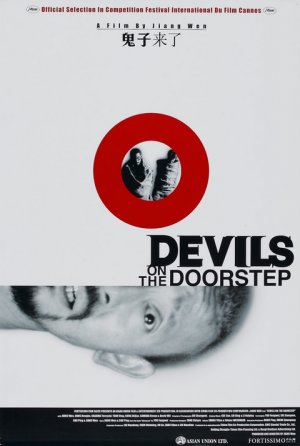
Devils on the Doorstep (Jiang Wen, 2000): Mini-Film Review
Jiang Wen's (director, writer, star) classic Devils on the Doorstep (2000) is a dark and brooding portrayal of 1945 China at the tail end of the Second Sino-Japanese War. Jiang Wen's film focuses on a group of peasants in rural Hebei China who are asked to hide two prisoners--a Japanese soldier and a Chinese collaborator--by a mysterious figure in the middle of the night who threatens to destroy the peasants' small town if they do not comply. Torn between following this strange order, staying true to their heritage and sound moral character, and avoiding the watchful eye of the encamped Japanese army, the peasants undergo a series of trials that occupy the liminal space between humor and terror until the film's climax. The film is shot in black and white with the exception of an unforgettable sequence captured in color.

Wednesday, March 9, 2016
Symposium: “Taiwan Cinema: Yesterday and Today” & Book Release
I'm grateful and excited to participate and present at an upcoming symposium & book launch for An Annotated Bibliography for Taiwan Film Studies (Columbia UP). An Annotated Bibliography for Taiwan Film Studies is my second book--it would not have been possible without Jim Cheng, the primary author, researcher, and director of the C. V. Starr East Asian Library at Columbia University who invited Japanese Studies Librarian Sachie Noguchi and myself to co-author it. Link to the event below:

April 21-22, 2016
Columbia University
Columbia University

Sponsored by Columbia University Libraries, Columbia University Press,
Weather Head East Asian Institute, and Ministry of Culture, Taiwan.
Sunday, March 6, 2016
Tokyo Story (Ozu, 1953): Mini-Film Review
Yasujirô Ozu's Tokyo Story (1953) represents an elderly couple's travels from small-town Japan to a bustling Tokyo in order to visit their grown children. Although the film moves slowly, interestingly the same question which
drives audience interest across multiple film genres--namely, "what will
happen next?"--is relevant for viewers here. In a sense, we
(always?) already know the answer, so we can reflect on the images as
they appear.
Ozu layers imagery in the film--traditional interior shots are collections of right angles, outdoor shots are comprised of diagonal stair-cases and train tracks, people move across streets and boats slide evenly across still water--contrasting stasis and movement. He is rightfully regarded as a master of the long take, even though his technique seems less noticeable today when compared with directors like Hou Hsiao-hsien--whose Café Lumière (2003) was produced as an homage to Ozu's film--and others. However Ozu, I believe, does not get enough credit for his dialogue, which is yet again evenly paced here. It carries the tenor of a film which is a meditation on inter-generational family relationships and the passage of time.
Ozu layers imagery in the film--traditional interior shots are collections of right angles, outdoor shots are comprised of diagonal stair-cases and train tracks, people move across streets and boats slide evenly across still water--contrasting stasis and movement. He is rightfully regarded as a master of the long take, even though his technique seems less noticeable today when compared with directors like Hou Hsiao-hsien--whose Café Lumière (2003) was produced as an homage to Ozu's film--and others. However Ozu, I believe, does not get enough credit for his dialogue, which is yet again evenly paced here. It carries the tenor of a film which is a meditation on inter-generational family relationships and the passage of time.
Tokyo Story Trailer on YouTube
Friday, February 26, 2016
Making a Murderer (dir. Laura Ricciardi & Moira Demos, 2015)
... just finished the 10 episode documentary, Making a Murderer by directors Laura Ricciardi and Moira Demos. Although it could have perhaps delivered its story in 7 or 8 episodes, I would highly recommend this thought-provoking series in its entirety. One of the primary questions of the story, as referenced in the title, is whether or not a man who was wrongly accused for 18 years was hardened into a criminal due serving time in the penal system--thus creating a criminal, which would explain his behavior after release--or if he was falsely accused for a murder after his release for which he is currently serving time. The evidence in the series strongly supports his innocence and thus it is heart-wrenching to consider that Steven Avery is in prison for a crime he did not commit.
This story has stayed with me, and it made me think about the ways narratives sustain ideas. Narratives can almost supernaturally suspend ideas for an indefinite period of time, like a note played on a wind instrument that is held beyond what we believe is possible. Sometimes they sustain ideas that are worth maintaining, ideas that would otherwise be fleeting. But by the grace of the author in general, and Ricciardi and Demos specifically, we focus on ideas longer here than we might otherwise, which leads us to new thought-associations that might not be realized if an idea were to emerge and drift away without the framework of a story.
Narratives do many things: they concretize ideology, they over-simplify chaos, they impose conformity where there is diversity. But when a narrative suspends an idea, as it does in Making a Murderer, so that we can walk underneath it, view it from multiple perspectives, sit down and stare at it, forget it when we doze off and then think of it again...the elephant in the room stays there a bit longer.
Sometimes a narrative represents an elephant in the room that is surprisingly calm, patient, impressive and awe-inspiring, and we never realized that such harmony within nature was possible. At other times, as we find here, the elephant in the room--in this case specifically the corrupt judicial system of Manitowoc County--keeps violently ramming into things, destroying precious objects, and it won't go away--and its presence is troubling because it is preventable.
This narrative sustains an idea, based on a historical circumstance, beyond our level of comfort...so what are we going to do about it? That's a good question here.
This story has stayed with me, and it made me think about the ways narratives sustain ideas. Narratives can almost supernaturally suspend ideas for an indefinite period of time, like a note played on a wind instrument that is held beyond what we believe is possible. Sometimes they sustain ideas that are worth maintaining, ideas that would otherwise be fleeting. But by the grace of the author in general, and Ricciardi and Demos specifically, we focus on ideas longer here than we might otherwise, which leads us to new thought-associations that might not be realized if an idea were to emerge and drift away without the framework of a story.
Narratives do many things: they concretize ideology, they over-simplify chaos, they impose conformity where there is diversity. But when a narrative suspends an idea, as it does in Making a Murderer, so that we can walk underneath it, view it from multiple perspectives, sit down and stare at it, forget it when we doze off and then think of it again...the elephant in the room stays there a bit longer.
Sometimes a narrative represents an elephant in the room that is surprisingly calm, patient, impressive and awe-inspiring, and we never realized that such harmony within nature was possible. At other times, as we find here, the elephant in the room--in this case specifically the corrupt judicial system of Manitowoc County--keeps violently ramming into things, destroying precious objects, and it won't go away--and its presence is troubling because it is preventable.
This narrative sustains an idea, based on a historical circumstance, beyond our level of comfort...so what are we going to do about it? That's a good question here.
"The truth always comes out": Making a Murderer Trailer on YouTube
Friday, February 12, 2016
Riding Alone for Thousands of Miles (Zhang, 2005): Mini-Film Review
Zhang Yimou's 2005 film Riding Alone for Thousands of Miles
depicts a Japanese father who travels to China to follow paths taken by
his estranged son who discovered his identity by losing himself within
the culture and landscape of the mainland. The father's personal mission
is conducted hastily since his son has a terminal illness. Along the
way, he finds his own path and meets a Chinese boy who helps the elderly man understand the
rift that separates him from his son in Japan. What interests me most when viewing it today is the way its parable-like
structure provides a vantage point into the psychology of China-Japan
relations.
Riding Alone for Thousands of Miles Trailer
Subscribe to:
Posts (Atom)