Monday, December 31, 2018

Deng Nan-guang's 8mm Movies (Deng,1935-1941): Mini-Film Review

Deng Nan-guang (1907-1971) was a well-regarded photographer in both pre- and post- colonized Taiwan who shot home movies that offer a candid portrayal of Taiwan life. The silent films recorded in Deng Nan-guang's 鄧南光 8mm Movies 家庭電影 (Deng 鄧南光,1935-1941) show Taiwan under Japanese rule: a leisurely afternoon spent fishing, Tamsui (淡水, Danshui), a school event at a local kindergarten with his son in attendance, a parade, and also scenes along the coast of Japan.

Taiwan's stunning tropical beaches and verdant mountain ranges are renowned. What is remarkable to see here is that all of the island looked like this at one time. Deng's images of Danshui remind me that Taipei once looked like Kenting. What a cool thing it is to see that here. Of course, the material condition and political situation at the time these images were made is powerful as well.

Deng Nan-guang's 8mm Movies x Wami Wang with Improvised Original Music on YouTube

For my complete list of Taiwan Cinema Toolkit film reviews, click this link here.
William Finnegan Discusses Kelly Slater's Wave Pool

An excellent video on the current state of surfing embedded from The New Yorker:

Sunday, July 29, 2018

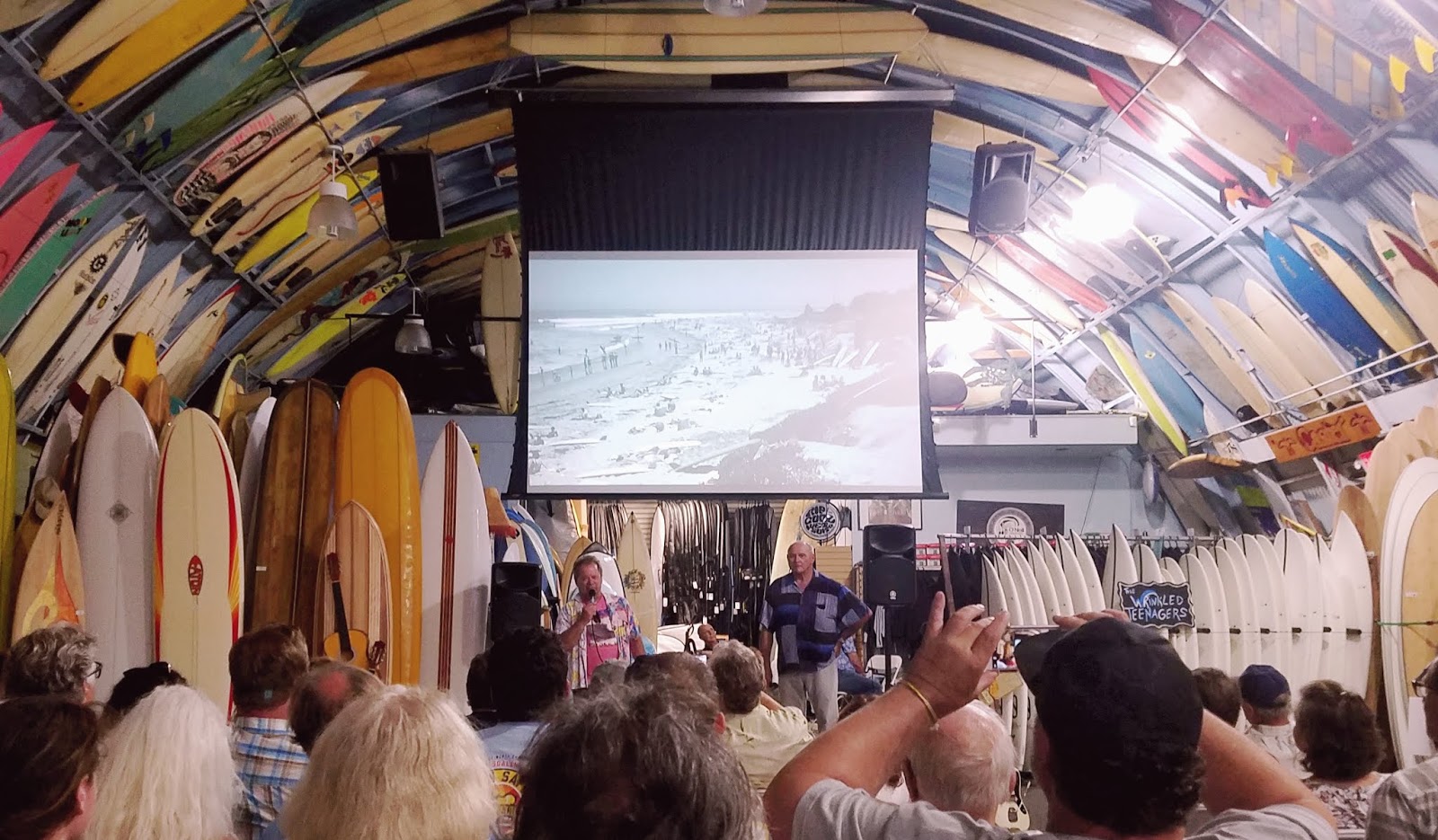
Big Wednesday: 40th Anniversary Screening at Bird's Surf Shed

On July 28th, 2018 Bird's Surf Shed hosted a surf film screening so surfer's could come out of the woodwork, hoot and holler at the screen, and have a great time together. Proceeds supported the UC San Diego Moores Cancer Center.

PT and Ian Cains at Bird's Surf Shed

In addition to watching Big Wednesday (Milius, 1978), stunt doubles were there to talk story: Ian Cairns and Peter Townend--surfing icons in their own right. Ira Opper shared behind-the-scenes photographs, and co-writer Dennis Aaberg narrated a video about the making of the movie. Pre-screening activities, music (the Wrinkled Teenagers!) and story, took around two hours so I actually left at the intermission before the film started, but I've seen it before and look forward to seeing it again after this experience.

Thursday, July 26, 2018

Love in Chilly Spring (Chen, 1979): Mini-Film Review

Love in Chilly Spring 春寒 (Chen 陈俊良, 1979) is pretty hard to watch. Super cheesy, and if you're only reading the subtitles, both unintelligible and laugh out loud funny (see image below). But the star power is evident--the film stars Taiwanese singer Fong Fei-Fei 鳳飛飛 (1953-2012)--and the story itself quite important in Taiwan's history. It takes place in Ilan during the Second Sino-Japanese War when Taiwan was under Japanese colonization, and it portrays a romance between two Taiwanese young people that is thwarted by a Japanese lieutenant. So is it so bad that it's good? For me, not so much.


For my complete list of Taiwan Cinema Toolkit film reviews, click this link here.

Tuesday, July 24, 2018

The Young Ones (Li, 1973): Mini-Film Review

The Young Ones 彩雲飛 (Li Xing 李行, 1973) is a classic romantic drama from early 1970s Taiwan. Adapted from a novel by Qiong Yao 瓊瑤, and starring Chen Chen 甄珍 and Alan Tang 鄧光榮, the film depicts a young man who loses his love interest to sickness, only to become attracted to a woman identical in appearance later in the film. The "shocking" twists and turns involve a set of twins separated by birth and tragic family histories.

The film is set in the most affluent, cosmopolitan sections of Taipei and briefly Hong Kong. And it features full-length song performances, a kind of MTV-esque quality found in many of the films of the time.

I can't help but think that the influence Li Xing's films had on the modernization of Taipei is underrated. What was once a small percentage of Taipei--as depicted in the film here--is now the norm in terms of communication, transportation, the arts, and global connectivity across all of Taiwan.


For my complete list of Taiwan Cinema Toolkit film reviews, click this link here.

Thursday, July 12, 2018

Four Moods (Bai, Hu, Li, Li, 1970): Mini-Film Review

Four Moods 《喜怒哀樂》is a portmanteau film, uneven in quality, yet still a must see film for any student or aficionado of Taiwan cinema of the 1960s and 70s because it showcases the four of the five major Taiwan directors (I would include Song Cunshou 宋存壽) of the era.

It is organized into four parts, each one focusing on a particular depiction of emotion taken from folklore: Bai Jingrui's 白景瑞 psychedelic experiment "Joy", King Hu's 胡金銓 tea house drama "Anger", Li Xing's 李行 melancholy representation of loss expressed via flashbacks in "Sadness", and Li Hanxiang's 李翰祥 intersection of the physical and spiritual worlds in "Happiness."

Surprisingly, Li Xing perhaps directs his best cinematic work in this film, a segment staring the absolutely superb Ou Wei 歐威 (pictured below). If you only check out one segment of this film to get an insight into the Taiwan mise-en-scène and aesthetics of the time, Li Xing's section is the one.


For my list of Taiwan Cinema Toolkit film reviews, click this link here.

Wednesday, July 11, 2018

Storm Over the Yangtse River (Li Han-Hsiang, 1969): Mini-Film Review

I remember the first time I saw Li Han-Hsiang's 李翰祥 1969 film Storm Over the Yangtse River 《揚子江風雲》--I was in a film viewing room in the Taiwan Film Institute on Qingdao East Road 青島東路 road in Taipei, I was concluding a research trip funded by Taiwan Ministry of Education in 2011 for an article on my favorite Taiwan film of the 1960s and 1970s (Li Hanxiang's The Winter 《冬暖》 (1969),  produced in the same year as Storm Over the Yangtse River), and I had only two hours before I needed to head to the Taoyuan International Airport and head back to the U.S.

It was a film I had to see, in addition to all of Li Hanxiang's major works, in order to discuss his film style and technique. Today, it's great to revisit this classic film--a standout of it's genre in Taiwan film history--restored with clear subtitles, although I do question why these genre film's translate "Japanese" as "Japs."

The film begins with startling black and white film reels of scenic locations in China, such as Beijing's Temple of Heaven, in order to demonstrate the importance of the motherland to Taiwan's film viewers in the late 1960s, and--via a "voice of god" narrator--to remind viewers of the atrocities committed by Japanese military aggression on the mainland during the Second Sino-Japanese War.

Storm Over the Yangtse River is perhaps a b-quality melodramatic film about a Chinese spy involved in a complex double-crossing scheme during World War II, but it is "A" quality when it comes to providing a window on pop culture during the Cold War. And true to Li Hanxiang's approach to narrative, it pulls out all the conventional stops of the time: sensuality, torture, action, war, love, patriotism, intrigue, murder, and last-minute rescues.

As the image (below) from the film demonstrates, Li Han-Hsiang was a big-time director who took a "go-big-or-go-home" mentality to his idea of what the silver screen could accomplish. His depictions of war contain numerous extras and his sets are the best of the era.


For my list of Taiwan Cinema Toolkit film reviews, click this link here.